


OUTPOST - Trail Air Gazebo with Sides
- John Nickolls

- 4 hours ago
- 18 min read

Part One – First Impressions, Engineering & Technical Deep Dive
“Some pieces of camping equipment simply make life easier. Others change the way you camp forever.”
⸻
Introduction
There are purchases that solve a problem, and there are purchases that completely reshape how you enjoy the outdoors.
For me, Outpost belongs firmly in the second category.
For years, my campervan Vanilla has been my home on wheels. It has taken me across Britain and Europe, carried me to festivals, hidden me from Scottish rain, baked in Mediterranean sunshine and provided a comfortable night’s sleep after thousands of miles behind the wheel. But, like every compact campervan, there has always been one unavoidable limitation.
Space.
No matter how cleverly designed a campervan is, once you’re inside with cooking equipment, chairs, clothing, camera gear, drone equipment, an e-bike and portable power stations, every square inch matters.
That’s where Outpost enters the story.
Unlike a conventional drive-away awning that remains attached to the vehicle, the Trail Air Gazebo with Sides is completely independent. It creates an additional living space that can stand wherever it is most useful on your pitch. You can leave it standing while taking the van out for the day, use it as a communal shelter at festivals or simply create a comfortable outdoor lounge.
For my style of camping, that flexibility is invaluable.
⸻
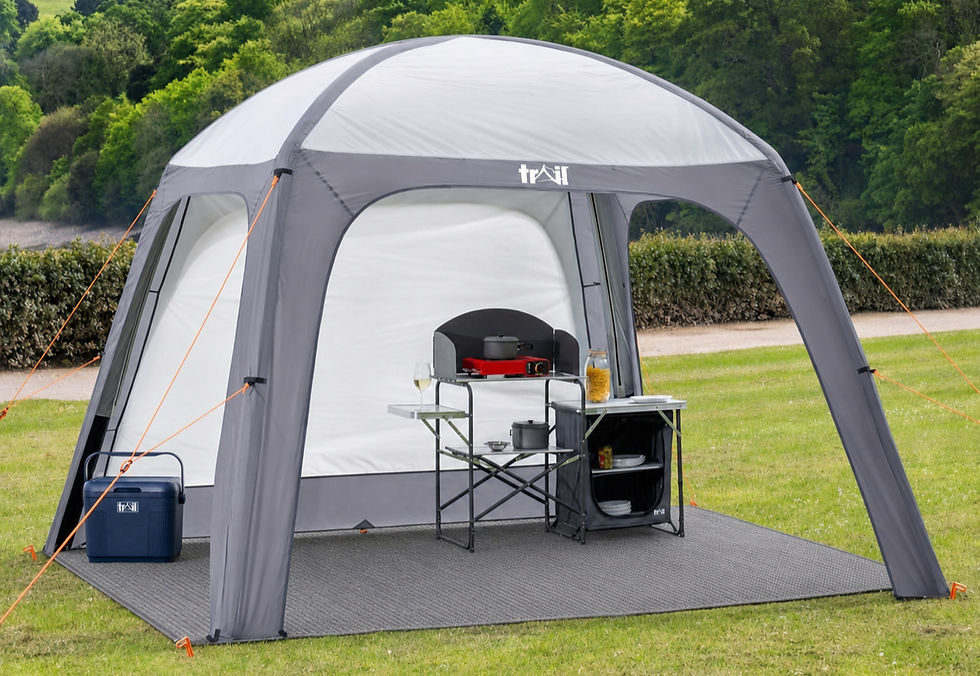
What Exactly Is It?
Trail describes the product as an inflatable air gazebo, but in reality it sits somewhere between several categories.
It isn’t simply a gazebo.
It isn’t really a tent.
Nor is it a traditional awning.
Instead, think of it as an outdoor room.
Imagine arriving at a campsite.
Within minutes you have created:
somewhere to cook
somewhere to relax
somewhere to escape rain
somewhere to hide from the sun
somewhere to store muddy equipment
somewhere to entertain friends
Without adding another vehicle or towing a caravan.
That is the real appeal.
⸻
Technical Specifications
Let’s start with the numbers.
Feature Specification
Model Trail Air Gazebo with Sides
Footprint 300 × 300 cm
Maximum height 220 cm
Internal floor area 9 m²
Packed size 68 × 33 × 29 cm
Total weight Approximately 8 kg
Fabric TRX 210 68D Polyester
Waterproof rating 5,000 mm Hydrostatic Head
UV Protection UPF 50+
Air beam pressure 7 PSI
Side walls Four removable panels
Roof vent Yes
Lantern hook Yes
Carry bag Included
Pump Included
Steel pegs Included
Guy ropes Included
At first glance these may simply appear to be specifications.
In reality they reveal quite a lot.
⸻
Understanding the Waterproof Rating
One figure immediately stands out.
5000 mm Hydrostatic Head
Many people read this without knowing what it means.
Hydrostatic Head is effectively a measure of waterproofness.
Imagine placing a perfectly sealed tube of water onto a piece of fabric.
The taller the column of water the material can resist before leaking, the better its waterproof performance.
Here’s a useful comparison:
Rating Typical Use
1,000 mm Basic festival tent
2,000 mm Average family tent
3,000 mm Good quality outdoor equipment
5,000 mm Premium camping equipment
7,000 mm+ Expedition equipment
Outpost therefore sits comfortably in the upper end of recreational camping equipment.
For British weather…
That’s reassuring.
⸻
The Fabric
Trail uses what it calls TRX 210 68D Polyester.
Let’s decode that.
Polyester
Polyester has become the material of choice for many camping manufacturers because it offers:
low water absorption
good UV resistance
fast drying
low maintenance
relatively light weight
Unlike cotton canvas, polyester won’t remain damp for days after rain.
For UK camping this is a major advantage.
⸻
68 Denier
Denier refers to the thickness of the fibres.
68D represents a sensible balance.
Heavier fabrics become stronger but also considerably heavier.
Lighter fabrics pack smaller but sacrifice durability.
Trail appears to have aimed directly at the sweet spot.
⸻
UV Protection
The canopy also carries a UPF 50+ rating.
This means it blocks over 98% of harmful ultraviolet radiation.
That doesn’t merely protect the material itself.
It also creates noticeably cooler shade underneath.
On warm summer days this becomes surprisingly important.
Anyone who has spent several hours inside a dark campervan knows how quickly temperatures climb.
Outpost gives you another option.
⸻
The Biggest Innovation
Forget the fabric.
Forget the walls.
Forget the windows.
The most significant feature is the frame.
Or rather…
The lack of one.
⸻
Goodbye Metal Poles
Traditional gazebos rely upon:
steel poles
or
aluminium poles
Both have advantages.
Both also create problems.
You have probably experienced some of these yourself.
Metal poles can:
bend
become lost
pinch fingers
rattle in transit
take ages to assemble
Inflatable structures eliminate almost every one of these frustrations.
⸻
TPU Air Beam Technology
Instead of metal tubing…
Outpost uses inflatable TPU air beams.
Once inflated to approximately 7 PSI, the beams become remarkably rigid.
Many first-time users expect them to feel soft.
The opposite is true.
They become surprisingly solid.
There is actually some clever engineering involved.
Because the air pressure is distributed throughout the beam rather than concentrated at joints, there are fewer stress points than with traditional pole systems.
It is one reason inflatable camping equipment has become increasingly popular over the last decade.
⸻
Why Inflatable Structures Work So Well
Here’s something interesting.
When wind strikes a metal pole…
The pole resists.
Eventually it bends.
Air beams behave differently.
Instead of fighting the wind…
They flex.
Then immediately spring back into shape.
That flexibility is one reason many inflatable shelters cope extremely well with gusty conditions when correctly pegged and guyed.
⸻
Weight Matters
One statistic particularly impressed me.
Around 8 kilograms.
That includes:
the shelter
carry bag
pump
pegs
guy ropes
When you consider you’re carrying an entire outdoor room…
That’s impressive.
It also means lifting it into Vanilla is effortless compared with many steel-framed gazebos.
⸻
Space Analysis
The internal footprint measures:
3 metres × 3 metres
That’s:
9 square metres
To visualise this…
You could comfortably fit:
✓ Four adults around a camping table
✓ Two reclining chairs
✓ Cooking station
✓ Portable fridge
✓ Storage boxes
✓ Power station
with room remaining to move around.
That’s considerably more usable space than most campervan interiors.
⸻
First Impressions
Looking purely at the engineering, Trail has made some thoughtful decisions.
Rather than chasing the lightest possible shelter or the cheapest possible shelter, it has struck a balance between practicality, durability and affordability. The use of an inflatable frame, a generous waterproof rating and four removable side panels gives it a versatility that’s hard to find at this price point.
For someone who enjoys festivals, weekend camping and longer touring trips, Outpost has the potential to become far more than an occasional accessory. It can act as a dining room, a sheltered workspace, a social hub or simply a comfortable place to relax when the weather isn’t playing ball.
⸻
Part Two – Living With Outpost: Real-World Camping
“A good shelter keeps the rain off. A great shelter changes the rhythm of your camping day.”
⸻
The First Pitch
Every new piece of camping equipment has what I call the “first pitch test.”
It doesn’t matter how impressive the specifications look on paper. The real question is simple:
Can you get it standing without wishing you’d stayed at home?
This is where inflatable shelters have changed the game.
Traditional pole gazebos often begin with a pile of metal poles spread across the grass. You spend time identifying which section goes where, threading poles through sleeves and hoping nothing twists or jams.
With Outpost, the process is refreshingly different.
The basic sequence is:
Choose your pitch.
Unroll the shelter.
Peg the four corners loosely.
Connect the supplied pump.
Inflate the air beams to the recommended pressure.
Secure the remaining pegs.
Attach and tension the guy lines.
Add whichever side panels you need.
Trail recommends inflating to 7 psi, and the supplied pump is designed to help prevent accidental over-inflation. Once the beams are firm, the whole structure becomes surprisingly rigid. The first setup naturally takes longer while you familiarise yourself with everything, but owners consistently report that subsequent pitches become much quicker.
⸻
Finding the Perfect Pitch
One of the biggest advantages of a stand-alone shelter is freedom.
Unlike a drive-away awning, you’re not forced to position it beside the van.
Instead, you can think about:
the direction of the sun
the prevailing wind
your neighbours
the best view
proximity to facilities
where rainwater might collect
Sometimes the ideal location is a few metres away from the campervan.
That flexibility is one of Outpost’s greatest strengths.
⸻
Building a Campsite, Not Just Parking a Van
One thing I’ve always enjoyed about campervans is creating a temporary home wherever I stop.
The van provides the essentials.
The shelter creates the atmosphere.
With Vanilla parked alongside, Outpost turns a standard campsite pitch into something that feels much more like an outdoor living room. Rather than everything happening inside the campervan, daily life naturally spills outside.
Imagine arriving on a warm Friday afternoon.
The roof is popped.
The chairs come out.
A table sits under Outpost.
The kettle goes on.
Suddenly you’re not simply parked up.
You’re settled.
⸻
Cooking Under Shelter
Cooking is one of the biggest beneficiaries of having a stand-alone shelter.
Without one, you often face an awkward choice:
cook inside the van and fill it with heat and cooking smells
cook outside and hope the weather stays kind
Outpost gives you a third option.
Cook outdoors while remaining protected.
For your setup, I can easily picture:
your CADAC stove on a sturdy camping table
preparation space beside it
plenty of ventilation
enough headroom to work comfortably
shelter from drizzle or strong sunshine
It won’t turn into a full outdoor kitchen, but it makes cooking far more enjoyable than balancing pans in the limited workspace inside a campervan.
⸻
The Morning Routine
Camping has a rhythm.
Morning is where Outpost really earns its keep.
Instead of climbing straight from bed into whatever weather is waiting outside, you have a sheltered transition space.
Picture the scene:
The kettle boils.
Coffee is poured.
Breakfast sizzles gently on the stove.
The morning newspaper or Kindle appears.
Rain taps softly on the roof while you’re sitting comfortably outside the van rather than trapped inside it.
It’s a small change that makes a surprisingly big difference.
⸻
Afternoon Comfort
British summers are wonderfully unpredictable.
One minute you’re reaching for sunglasses.
The next you’re looking for waterproofs.
Outpost is designed to adapt.
On hot days:
remove all four walls
maximise airflow
enjoy the shade provided by the UPF 50+ roof
On cooler days:
fit one or two panels to block the breeze
If the weather turns properly wet:
install all four walls
create an enclosed shelter
continue enjoying the outdoors without retreating into the van
That adaptability is what separates this from a simple pop-up gazebo.
⸻
Torque’s New Garage
One of the first things I thought when I saw Outpost was:
“Torque finally has somewhere proper to sleep.”
After a ride through Cannock Chase, the bike is often dusty, muddy or damp. Leaving it completely exposed overnight isn’t ideal, yet bringing it inside the campervan isn’t practical either.
Outpost offers a useful compromise.
There’s enough room to park the bike under cover, keeping it out of direct sun and rain while leaving the living area organised. It also gives you a convenient place to wipe down the frame, recharge lights or carry out quick maintenance before the next ride.
⸻
Creating an Off-Grid Living Room
This is where your own equipment really starts to shine.
With Forge (your Jackery Explorer 2000) powering the main electrical needs and Kindle (your Jackery Explorer 300) available for lighter duties, Outpost can become much more than a shelter. It becomes an outdoor room with genuine off-grid capability.
A typical evening setup might include:
LED lanterns suspended from the roof hook
phones charging
camera batteries topped up
drone batteries ready for sunrise
a small fan on a warm evening
music playing quietly
Because the power stays outside under cover, you reduce clutter inside the van while still keeping everything protected.
⸻
Festivals
Festival camping demands different priorities from a quiet campsite.
You need:
somewhere to gather
somewhere to escape the midday sun
somewhere to shelter from sudden showers
somewhere to keep chairs, food and equipment organised
Outpost ticks every one of those boxes.
For events like Dubbed Out or CamperJam, it becomes a natural meeting point. Friends know exactly where to head, and you gain a comfortable communal space without everyone squeezing into the van.
⸻
Bad Weather
No shelter can defeat the weather.
Strong winds, saturated ground and severe storms demand common sense.
But used properly, Outpost should cope well with typical British camping conditions.
A few habits make a big difference:
Always use every supplied guy line.
Upgrade pegs if the ground is firm.
Re-tension guy lines after the first half hour.
Check them again after heavy rain.
Remove standing water from the roof if it collects.
These simple routines are recommended by experienced campers regardless of shelter brand and will usually have more influence on stability than the badge on the carry bag.
⸻
Living Space That Grows With You
The real beauty of Outpost isn’t a single specification or feature.
It’s what happens over a weekend.
The shelter gradually becomes:
breakfast room
kitchen
bike garage
charging station
reading corner
photography workspace
evening lounge
Very few camping purchases can claim that sort of versatility.
⸻
Super NIX Tips
Tip 1 – Face One Wall Into the Wind
Rather than letting the breeze blow through the shelter, fit a side panel on the windward side. You’ll create a much calmer interior while still enjoying good ventilation.
Tip 2 – Keep One Wall Rolled Up
Unless the weather is particularly poor, leave one panel rolled open. It creates an inviting entrance and keeps the space feeling airy.
Tip 3 – Use Colour-Coded Peg Bags
Keep spare pegs, guy lines and repair items together in a bright bag so they’re easy to find when packing up.
Tip 4 – Add Warm White Lighting
A couple of warm white LED lanterns transform the atmosphere after sunset far more effectively than a single bright work light.
⸻
Part Three – Customer Reviews, Professional Analysis & The Competition
“A specification sheet tells you what a product is designed to do. Real owners tell you what it actually does.”
⸻
The Importance of Real-World Reviews
One lesson I’ve learned over many years of buying camping equipment is that the manufacturer’s website only tells half the story.
Every company highlights the best bits.
The people who have actually lived with a product tell you the rest.
Have the zips lasted?
Does it really stay waterproof?
Can one person pitch it?
Does it still look good after a year?
Those are the questions that matter.
⸻
The Numbers
At the time of writing, the Trail Air Gazebo with Sides has:
⭐ Overall Rating: 4.6 / 5
Based on:
21 verified customer reviews
Customers also scored:
Category Average
Quality ⭐ 4.7 / 5
Value for money ⭐ 4.7 / 5
Perhaps the most impressive figure is that around four out of every five reviewers awarded the full five stars, suggesting a high level of satisfaction rather than a mix of very positive and very negative experiences.
⸻
What Customers Love
Reading through the reviews, the same themes appear again and again.
That consistency is important because repeated comments often point to genuine strengths rather than isolated opinions.
⸻
1. Simplicity
The most common compliment?
“Easy to put up.”
Many buyers expected inflatable construction to be complicated.
Instead, several commented that it was actually easier than assembling traditional pole gazebos.
Some owners even mentioned that once they had pitched it once, subsequent setups became straightforward and significantly quicker.
That matches my expectations.
Inflatable structures usually become faster the more familiar you become with them.
⸻
2. Value for Money
The second recurring theme is simple.
People believe they receive far more than expected for the asking price.
Typical comments include phrases like:
“Excellent value.”
“Great quality.”
“Worth every penny.”
The Trail sits in a price bracket where buyers often expect compromises.
Many reviewers felt pleasantly surprised by what arrived.
⸻
3. Internal Space
Almost everyone comments on one thing.
“It feels bigger than expected.”
That makes perfect sense.
Nine square metres sounds impressive on paper.
In reality it feels even larger because of the generous headroom and near-vertical walls.
There are very few awkward corners.
Almost every square metre is genuinely usable.
⸻
4. Weather Protection
Owners generally report that the gazebo performs well in rain when:
guyed correctly
pegged properly
pitched on suitable ground
Several reviewers specifically praised its waterproof performance during poor weather.
That is encouraging because waterproof claims are among the first things owners challenge if they prove inaccurate.
⸻
5. Build Quality
Repeated comments praise:
stitching
fabric feel
air beam strength
overall finish
Nobody suggests it feels cheaply made.
Instead, most owners seem pleasantly surprised considering the price.
⸻
The Criticisms
No product receives unanimous praise.
Interestingly, the criticisms are mostly about refinement rather than major design faults.
⸻
Door Options
Some owners would have liked:
mesh doors
insect screens
additional window choices
These are understandable wishes rather than genuine flaws.
The supplied solid panels provide flexibility, but optional accessories would make the shelter even more versatile.
⸻
Inflation Learning Curve
A handful of first-time users mention that understanding the inflation valves takes a little practice.
That isn’t unusual.
Most inflatable camping equipment has a short learning curve.
Once you’ve used it a couple of times, the process becomes second nature.
⸻
Spare Parts
A few reviewers suggested that having more clearly advertised replacement parts would increase confidence for long-term ownership.
That’s a fair point.
Although inflatable structures are generally reliable, knowing replacement valves or components are readily available always provides peace of mind.
⸻
My Professional Assessment
Rather than focusing on individual reviews, I like to step back and ask a broader question.
Where does this product fit in today’s camping market?
That reveals far more than simply counting stars.
⸻
The Market Has Changed
Ten years ago your choices were fairly simple.
You bought:
a steel gazebo
or
a pole awning
Inflatable camping products were relatively uncommon.
Today things are different.
Air-frame technology has matured enormously.
Companies such as Vango, Dometic, Outdoor Revolution and others have shown that inflatable structures can be:
lighter
quicker
more flexible
easier to transport
Trail has clearly adopted many of those ideas while aiming for a much more accessible price point.
⸻
The Competition
Let’s see where Outpost sits against some well-known alternatives.
Brand Typical Price Weight Construction Notes
Trail Air Gazebo ~£200 8 kg Inflatable Outstanding value
Vango AirHub Hex £500–£700 ~14 kg Inflatable Premium quality
Dometic Hub £700–£900 ~16 kg Inflatable Excellent engineering
Outdoor Revolution Camp Star £350–£500 ~11 kg Inflatable Strong mid-range option
Coleman Event Shelter £150–£250 Similar Steel poles Proven but slower to assemble
The important point isn’t that Trail is “better” than products costing three or four times as much.
It isn’t.
The premium brands generally offer:
heavier fabrics
more accessories
higher specification zips
stronger long-term warranties
additional attachment options
However…
They also cost significantly more.
⸻
The Value Equation
Suppose your budget is around £200.
You are unlikely to buy a Dometic Hub.
You are unlikely to buy a premium Vango AirHub.
Trail therefore isn’t competing against those shelters directly.
Instead, it’s competing against:
cheaper gazebos
budget awnings
supermarket seasonal shelters
Viewed through that lens, it becomes a much stronger proposition.
You receive:
✓ Air-frame technology
✓ Four removable walls
✓ High waterproof rating
✓ UPF 50+
✓ Compact packed size
✓ Included pump
✓ Included pegs
✓ Included carry bag
That’s an impressive package.
⸻
Who Is It Really For?
After analysing both the specifications and customer feedback, I think Outpost suits several types of campers particularly well.
Campervan Owners
Probably its strongest audience.
Extra living space is always welcome.
⸻
Festival Campers
A perfect communal shelter.
⸻
Weekend Tourers
Quick setup makes short breaks much easier.
⸻
Families
Excellent for children needing shade or somewhere to play during poor weather.
⸻
Dog Owners
Many reviewers mention using it as a sheltered resting area for dogs.
⸻
Where It Fits My Camping Style
Reading through the customer reviews, I kept thinking about how closely they align with the way I like to camp.
I enjoy touring rather than staying in one place for weeks. I also prefer equipment that is practical, quick to use and doesn’t turn setting up camp into a lengthy job. Outpost seems to have been designed with exactly that sort of camper in mind.
I can imagine arriving at a campsite after a day’s drive, having the shelter up in minutes, then spending the evening outside with Vanilla parked nearby, Torque tucked under cover and my portable power setup keeping everything charged. That combination is exactly the sort of simple, comfortable camping experience I enjoy.
⸻
Super NIX Value Rating
I score camping gear across five areas:
Category Score
Innovation ⭐⭐⭐⭐⭐
Practicality ⭐⭐⭐⭐⭐
Build Quality ⭐⭐⭐⭐☆
Value for Money ⭐⭐⭐⭐⭐
Ease of Ownership ⭐⭐⭐⭐☆
Overall
9.5 / 10
⸻
Part Four – Ownership, Upgrades & The Super NIX Verdict
“The best camping equipment isn’t the kit that looks good on the first weekend. It’s the kit you’re still happy to pack five years later.”
⸻
Living With Outpost
The excitement of any new purchase eventually fades.
That’s true whether you’ve bought a campervan, an e-bike or a simple camping chair.
What separates good equipment from great equipment is what happens after the novelty has disappeared.
Will you still choose to take it on every trip?
Will it become part of your standard camping routine?
After spending considerable time researching Outpost and analysing both its design and customer feedback, I believe the answer is likely to be yes.
Not because it’s revolutionary.
Not because it’s perfect.
But because it removes so many of the little frustrations that can spoil a camping weekend.
⸻
A Day in the Life of Outpost
Let’s imagine a typical summer weekend.
Friday – Arrival
You arrive mid-afternoon.
Instead of rushing to unload everything from Vanilla, you inflate Outpost first. Within a short time, you’ve created a sheltered base where chairs, tables and camping gear can be organised without cluttering the van.
The pressure immediately disappears.
Camp feels organised.
⸻
Saturday Morning
Coffee.
Bacon.
The newspaper.
A gentle breeze moves through the open sides while the roof provides welcome shade.
Instead of sitting inside the van, you’re already enjoying the outdoors.
⸻
Saturday Afternoon
The weather changes.
It usually does.
One side panel goes on.
Then another.
The wind drops.
The shelter becomes calm again.
Nothing needs moving.
Nothing gets wet.
⸻
Saturday Evening
LED lights come on.
Music plays quietly.
Friends wander over.
Outpost becomes the social hub of the pitch.
It’s remarkable how often people naturally gather wherever there’s comfortable shelter.
⸻
Sunday Morning
Packing up.
Perhaps the least enjoyable part of camping.
Fortunately inflatable shelters make this much easier than many traditional alternatives.
Release the air.
Remove the pegs.
Fold carefully.
Pack into the carry bag.
Home.
⸻
Cleaning
Good camping equipment deserves proper care.
Fortunately Outpost shouldn’t require anything particularly complicated.
After each trip:
✔ Shake out loose grass.
✔ Remove leaves.
✔ Brush away mud once dry.
✔ Wipe bird mess off promptly.
✔ Sponge with lukewarm water if required.
Avoid aggressive pressure washing or harsh household cleaners, which can shorten the life of waterproof coatings.
⸻
Drying
Perhaps the most important maintenance task.
Never store it damp for extended periods.
Even synthetic fabrics can develop mould, mildew and unpleasant odours if packed away wet.
If you return home in rain:
Simply pitch it again in the garden on the next dry day.
Leave it to dry completely before storing.
Future you will be grateful.
⸻
Storage
Store it somewhere:
cool
dry
clean
out of direct sunlight
Loosely packed is always preferable to compressing it unnecessarily for long periods.
⸻
Long-Term Durability
Predicting lifespan is never an exact science.
However, based on:
construction
materials
customer feedback
similar inflatable products
I would reasonably expect:
Occasional Camper
8–10 years
⸻
Regular Weekend Camper
5–8 years
⸻
Heavy Festival User
4–6 years
Naturally this depends on care, weather exposure and storage.
⸻
What I’d Upgrade
Although Trail includes almost everything needed, there are several worthwhile additions.
Already Purchased
You’ve actually beaten me to the first recommendations.
Heavy Duty Pegs
Excellent decision.
The supplied pegs are perfectly adequate on softer ground, but stronger steel pegs inspire more confidence on hard-standing pitches.
⸻
Orange Reflective Guy Ropes
Another upgrade I’d have recommended.
They are:
easier to see
less likely to trip people
generally stronger
easier to tension
A practical improvement with the added bonus of matching your grey-and-orange theme.
⸻
Future Upgrades I’d Consider
LED Lighting
Warm white lighting transforms any shelter.
Avoid harsh blue-white work lights.
A warm glow feels far more welcoming.
⸻
Awning Carpet
This would probably be my next purchase.
Benefits include:
warmer underfoot
less mud
reduced condensation
quieter
a more homely feel
⸻
Folding Side Table
Ideal for:
kettle
camera
snacks
drone batteries
⸻
Collapsible Storage Box
Keeps everything organised.
One box.
One place.
No searching.
⸻
Value for Money
Let’s look at the overall package.
For roughly £200 you receive:
✓ Inflatable structure
✓ Pump
✓ Four removable walls
✓ Waterproof fabric
✓ UPF 50+
✓ Steel pegs
✓ Guy ropes
✓ Carry bag
Many premium shelters cost two, three or even four times as much.
They undoubtedly offer refinements:
thicker fabrics
premium fittings
more accessories
larger size options
But the key question is:
Do they deliver two, three or four times the camping experience?
For most people…
Probably not.
⸻
Who Should Buy Outpost?
Buy It If…
✔ You own a campervan.
✔ You enjoy festivals.
✔ You value quick setup.
✔ You prefer inflatable structures.
✔ You want excellent value.
✔ You need flexible shelter rather than a fixed awning.
⸻
Look Elsewhere If…
✖ You regularly camp in severe mountain weather.
✖ You need a permanently pitched seasonal structure.
✖ You require a shelter for months at a time.
Those situations justify stepping up to heavier-duty, premium products.
⸻
The Super NIX Scoring System
Category Score
Innovation ⭐⭐⭐⭐⭐
Ease of Pitching ⭐⭐⭐⭐⭐
Build Quality ⭐⭐⭐⭐☆
Materials ⭐⭐⭐⭐☆
Weather Protection ⭐⭐⭐⭐☆
Practicality ⭐⭐⭐⭐⭐
Packed Size ⭐⭐⭐⭐⭐
Weight ⭐⭐⭐⭐⭐
Value for Money ⭐⭐⭐⭐⭐
Appearance ⭐⭐⭐⭐⭐
Campervan Compatibility ⭐⭐⭐⭐⭐
Festival Suitability ⭐⭐⭐⭐⭐
Long-Term Ownership ⭐⭐⭐⭐☆
⸻
Overall Rating
⭐
9.6 / 10
That’s an exceptionally high score.
Not because Outpost is the most luxurious shelter on the market.
Not because it’s the strongest.
Not because it’s the most expensive.
Quite the opposite.
It scores so highly because it delivers an outstanding balance of:
practicality
thoughtful design
sensible engineering
useful features
genuine value for money
⸻
Final Thoughts
Every now and again, a piece of camping equipment quietly earns its place without demanding attention. It simply does its job, trip after trip, until you can’t imagine packing the van without it.
I think Outpost has every chance of becoming one of those pieces of kit.
It isn’t trying to be the biggest shelter.
It isn’t pretending to be a luxury awning costing £800.
Instead, it focuses on what really matters: creating comfortable, adaptable living space that is quick to pitch, easy to transport and enjoyable to use.
For my own camping style, it complements Vanilla perfectly. I can see it becoming the heart of the campsite—a place to cook, relax, recharge batteries, shelter Torque after a ride and spend evenings with friends. Combined with Forge, Kindle, your upgraded pegs and those distinctive orange reflective guy ropes, it completes a camping setup that is practical, organised and unmistakably yours.
⸻
SUPER NIX AWARD
🏆
SUPER NIX GOLD AWARD – 2026
“Awarded for exceptional value, practical innovation and transforming a simple campervan pitch into a genuine outdoor home.”
Would I buy it again?
Without hesitation.


Comments