


🧂🔫 THE BUG-A-SALT CHRONICLES
- John Nickolls

- Jul 8
- 19 min read
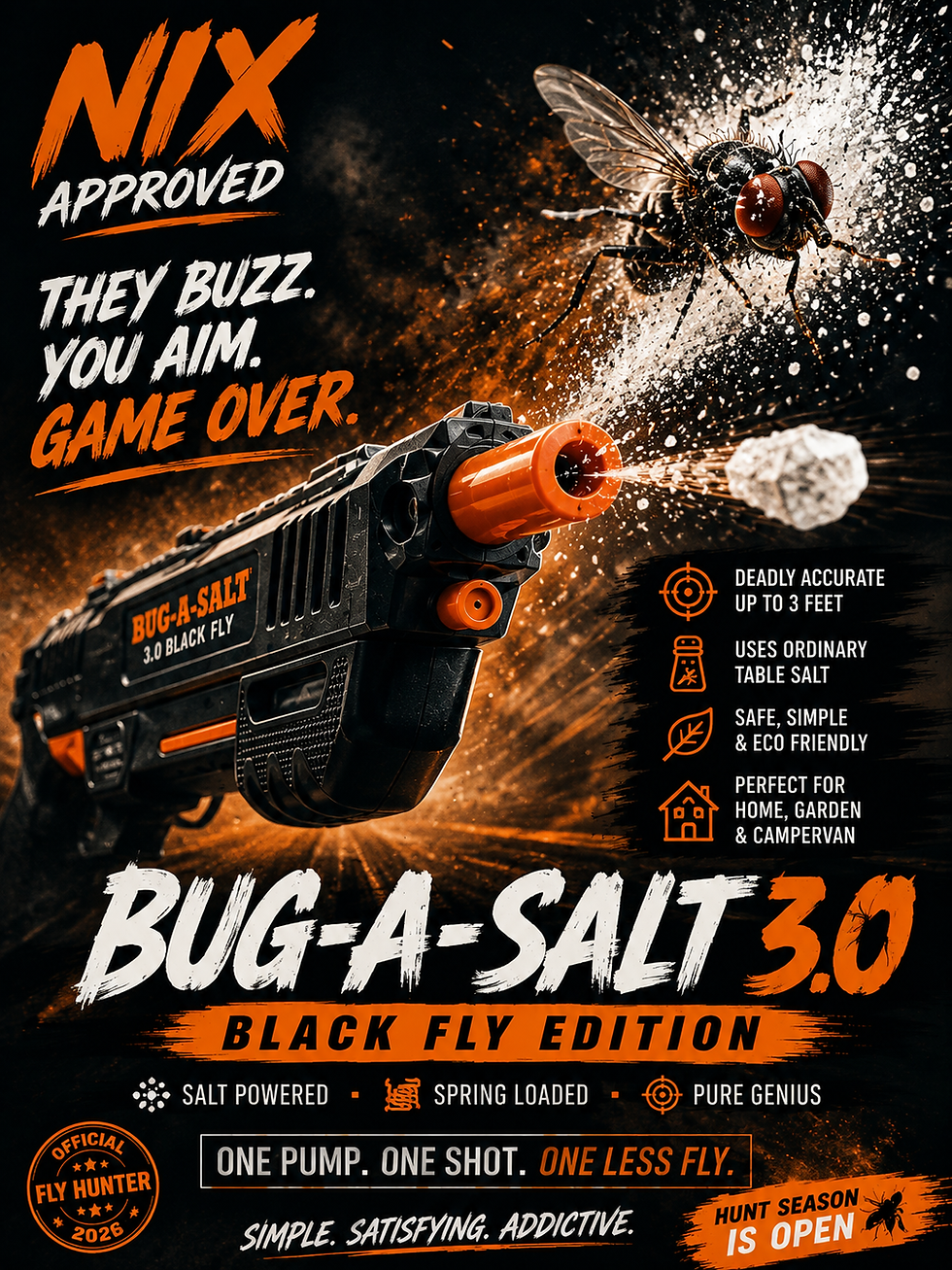
Part One – The Fly Hunter Begins
A Super Nix Feature by John Nickolls
⸻
“Some people collect watches. Others restore classic cars. I, apparently, have reached the stage in life where I’m genuinely excited about a plastic gun that fires table salt at flies.”
If you’d told twenty-year-old me that one day I’d be eagerly waiting for a courier to deliver what is essentially a glorified salt shaker with a trigger, I’d probably have laughed.
Yet there I was.
Watching my phone.
Tracking the parcel.
Refreshing the delivery app every half an hour.
Then, finally…
“Your package has been delivered.”
Brilliant.
Inside the box were two Bug-A-Salt Black Fly 3.0s.
One for me.
One for my son.
It struck me that this wasn’t just another online purchase. It was one of those rare gadgets that combines engineering, simplicity and childlike fun in equal measure. The sort of invention that makes you wonder why nobody thought of it fifty years ago.
So, naturally, I did what every curious engineer does.
Before even loading the salt…
I wanted to know exactly how it worked.
That simple curiosity sent me down one of the most enjoyable rabbit holes I’ve disappeared into for quite some time.
This isn’t simply a review.
It’s the story of an invention that transformed one of mankind’s oldest annoyances into a strangely satisfying hobby.
Welcome to the Bug-A-Salt.
⸻
Chapter One
The Enemy We All Know
Flies have been annoying human beings for thousands of years.
Long before electricity.
Long before insect sprays.
Long before supermarkets sold fly swatters in fluorescent colours.
Flies were there.
Imagine sitting around a fire in Roman Britain.
You’re trying to enjoy your evening meal.
A fly lands on your bread.
You wave it away.
It comes back.
Again.
And again.
Fast forward two thousand years.
The technology has changed dramatically.
We carry computers in our pockets.
Cars drive themselves.
My Scott e-bike contains more computing power than the Apollo spacecraft.
Yet somehow…
One tiny housefly can still reduce an intelligent adult into waving a tea towel around the kitchen like a man possessed.
Some things never change.
⸻
The Tiny Terror
Houseflies aren’t particularly clever individually.
Their brains are tiny.
Yet collectively they’ve evolved into almost perfect survivors.
Their eyes contain thousands of individual lenses.
Instead of seeing smooth moving images like we do, they detect incredibly rapid changes in light and movement.
To a fly…
We’re almost moving in slow motion.
That’s why swatting them is so frustrating.
By the time you’ve decided to move…
The fly has already calculated your trajectory.
It simply lifts off.
You miss.
The fly wins.
Again.
Scientists estimate a fly can react several times faster than a human.
No wonder they’re difficult to hit.
⸻
Every Home Has One
It doesn’t matter how clean your house is.
Open the patio doors.
Leave the conservatory window open.
Bring shopping in.
Open the campervan while making lunch.
Somehow…
A fly appears.
It’s almost as though they have a secret WhatsApp group.
“Door open at John’s place…”
“Kitchen accessible…”
“Proceed immediately…”
Within minutes they’re buzzing lazily around the ceiling.
Not causing any real damage.
Just enough irritation to become impossible to ignore.
⸻
My Traditional Methods
Like everyone else, I’ve tried everything.
Rolled-up newspaper.
Success rate?
About twenty percent.
Fly swatter?
Better.
Until you hit the wall slightly too hard.
Electric tennis racket?
Great fun…
Until you forget where you’ve put it.
Aerosol fly spray?
Effective.
But now the entire kitchen smells like a chemistry laboratory.
Besides…
I’ve never particularly liked spraying chemicals around food preparation areas.
Especially in the campervan.
That leaves us with one obvious question.
Could there possibly be a better solution?
⸻
The Day Everything Changed
Some inventions are born from billion-pound laboratories.
Others…
Begin with pure frustration.
The Bug-A-Salt exists because one ordinary bloke became fed up chasing flies around his kitchen.
Instead of accepting the problem…
He asked a completely different question.
“What if I could shoot them?”
Not with pellets.
Not with BBs.
Not with darts.
With…
Salt.
Ordinary kitchen salt.
It sounds ridiculous.
Until you think about it.
Salt is everywhere.
It’s cheap.
It’s safe to handle.
It’s environmentally benign.
And individual grains are surprisingly hard.
That simple thought eventually became one of the cleverest household gadgets ever invented.
⸻
Engineering Simplicity
I’ve always admired products that solve complicated problems using remarkably simple engineering.
The best examples?
The paperclip.
The zip.
The humble bicycle.
The adjustable spanner.
The mousetrap.
None rely on electronics.
None require software updates.
They simply work.
The Bug-A-Salt belongs firmly in that category.
There isn’t a battery.
No Bluetooth.
No Wi-Fi.
No charging cable.
No QR code asking you to download an app.
Imagine that in 2026.
Buying a product…
That just works.
Straight out of the box.
It almost feels revolutionary.
⸻
The Delivery
The courier handed over a surprisingly compact parcel.
Nothing fancy.
No unnecessary packaging.
Just enough protection to get the contents safely to my front door.
Inside…
Two beautifully moulded Bug-A-Salt Black Fly 3.0 blasters.
Black.
Orange.
Purposeful.
The styling immediately reminded me of something halfway between a Nerf blaster and a sci-fi movie prop.
It doesn’t pretend to be anything it’s not.
It looks fun.
It feels robust.
Most importantly…
It makes you smile before you’ve even used it.
That’s a rare achievement.
⸻
First Impressions
Picking it up for the first time, I was pleasantly surprised by the weight.
It’s light enough to use one-handed.
Yet substantial enough not to feel cheap.
The grip fits naturally into the hand.
The pump mechanism slides smoothly.
The trigger has a reassuring amount of resistance.
Even without firing a shot, you get the impression somebody actually cared about the ergonomics.
This wasn’t thrown together.
It has clearly been designed by people who understand that using a product should feel satisfying.
⸻
Why Two?
Most people would buy one.
I ordered the twin pack.
Not because I needed two.
Because I already knew exactly where the second one was going.
My son.
It’s the sort of gift that almost guarantees a grin.
Not expensive enough to feel extravagant.
Not ordinary enough to be forgotten.
Just quirky enough to become memorable.
Years from now he’ll probably remember receiving the Bug-A-Salt far more vividly than another pair of socks or a bottle of aftershave.
Those are usually the best presents.
⸻
A Different Kind of Gadget
The older I get, the more I appreciate products with a single purpose.
One job.
Done exceptionally well.
My Panasonic bread maker makes bread.
My Bosch-powered Scott e-bike gets me into the forests of Cannock Chase.
My campervan carries me across Europe.
The Bug-A-Salt?
It removes flies.
That’s all.
And somehow…
That’s enough.
⸻
What’s Coming Next…
By now, you might be wondering:
How can a handful of ordinary table salt possibly become an effective projectile?
In Part Two – Engineering Genius, I’ll strip the Bug-A-Salt down piece by piece and explain exactly what’s happening inside every time you pump the action and pull the trigger.
We’ll explore the spring mechanism, piston, airflow, barrel geometry, the science of salt as ammunition, and why the Black Fly 3.0 is so much more effective than it has any right to be.
I promise you this: once you understand the engineering, you’ll never look at a humble bag of table salt in quite the same way.
To be continued…
🧂🔫 THE BUG-A-SALT CHRONICLES
Part Two – Engineering Genius
The Incredible Science Behind the World’s Most Satisfying Fly Swatter
A Super Nix Feature by John Nickolls
⸻
“Good engineering isn’t about making something complicated. It’s about making something brilliantly simple.”
The older I get, the more I admire clever engineering.
Not engineering that requires software updates.
Not engineering that needs a smartphone app.
Not engineering hidden behind a touchscreen.
Real engineering.
Springs.
Levers.
Bearings.
Gears.
Simple mechanisms that quietly perform their job year after year without fuss.
The Bug-A-Salt belongs firmly in that category.
At first glance it looks like a toy.
Spend five minutes examining it…
…and you’ll discover it’s actually a beautifully thought-out mechanical device.
Every part has a purpose.
Every movement transfers energy.
Every gram of salt is accelerated by nothing more than physics.
As someone who served as a Marine Engineering Mechanic in the Royal Navy before spending decades around heavy lorries and machinery, I can’t help appreciating clever mechanical design.
The Bug-A-Salt is one of those gadgets that rewards curiosity.
⸻
Chapter One
Inside the Beast
Imagine shrinking an air cannon until it fits in one hand.
That’s essentially what Bug-A-Salt has achieved.
There isn’t a motor hidden inside.
No compressed gas cylinder.
No rechargeable battery.
No electronics whatsoever.
Instead…
Everything begins with you.
Your arm provides the energy.
Your hand compresses the spring.
Your finger releases it.
The gun simply converts that stored energy into an extremely fast pulse of moving air.
That pulse does all the hard work.
⸻
Mechanical Energy
Think back to school science.
Energy cannot simply disappear.
It changes form.
When you rack the Bug-A-Salt…
Your muscles are doing work.
That work becomes stored energy inside the spring.
The spring wants to expand.
Immediately.
But the trigger mechanism locks everything into place.
You are literally holding potential energy in your hand.
It sits there patiently.
Waiting.
Then…
Click.
The trigger releases.
Everything happens in a fraction of a second.
⸻
The Pump Action
One of the cleverest parts of the design is the pump.
It isn’t there for dramatic effect.
It performs several jobs simultaneously.
As you slide the pump backwards:
• the spring compresses
• the piston locks
• the trigger engages
• the chamber prepares for firing
Every movement has been engineered to happen in the correct sequence.
If you’ve ever operated a pump-action shotgun you’ll immediately recognise the motion.
Obviously the Bug-A-Salt is a completely different device, but the ergonomics are familiar.
It’s satisfying.
Positive.
Deliberate.
That satisfying clack-clack isn’t accidental.
Humans enjoy tactile feedback.
Engineers know this.
⸻
Springs Are Wonderful Things
Springs are incredibly underrated.
Open almost anything mechanical…
You’ll probably find one.
Car suspension.
Door handles.
Pens.
Mouse traps.
Clocks.
Power tools.
The Bug-A-Salt relies entirely upon one.
That spring quietly stores an astonishing amount of energy considering its size.
Not dangerous energy.
Just enough to move air incredibly quickly.
It’s rather like stretching a catapult.
The further you pull…
The more energy it stores.
Release it…
Everything happens instantly.
⸻
Meet the Piston
The piston is really the heart of the Bug-A-Salt.
Imagine placing your finger over the end of a bicycle pump.
Push quickly.
You feel pressure building immediately.
That’s exactly what’s happening.
The piston races forward.
Air has nowhere to go.
Pressure rises.
The only available escape route…
Is through the barrel.
That escaping air becomes the invisible engine pushing the salt forwards.
Not the spring.
Not the piston.
The air itself.
It’s beautifully elegant.
⸻
Air Is Surprisingly Powerful
People often underestimate air.
After all…
You can’t see it.
But compressed air powers factories.
Controls trains.
Operates brakes on heavy goods vehicles.
Raises enormous vehicle lifts.
Drives industrial tools.
In the Bug-A-Salt the same principle is miniaturised.
The pressure pulse lasts only milliseconds.
Yet that’s all that’s needed.
The air never touches the fly.
It simply accelerates the salt.
The salt does the rest.
⸻
Why Not Fire One Pellet?
Excellent question.
One grain of salt would be incredibly difficult to aim.
Imagine trying to hit a fly with a single grain.
Almost impossible.
Instead…
The Bug-A-Salt fires dozens of tiny grains simultaneously.
Engineers call this a shot pattern.
Instead of relying upon pinpoint accuracy…
You create a controlled cloud.
One tiny mistake in aiming doesn’t matter.
Some grains will still arrive exactly where needed.
It’s surprisingly similar to shotgun philosophy.
A pattern rather than a single projectile.
⸻
Why Table Salt?
Here’s something fascinating.
Salt is almost the perfect ammunition.
It is:
Heavy enough.
Hard enough.
Dry enough.
Small enough.
Cheap enough.
Safe enough.
Readily available almost everywhere on Earth.
Very few materials tick every one of those boxes.
Sugar?
Too sticky.
Sand?
Variable size.
Rice?
Far too large.
Flour?
Creates dust.
Salt wins.
Every time.
⸻
Why Fine Salt Works Better
This is one of the first lessons experienced Bug-A-Salt owners discover.
Use ordinary fine table salt.
Not rock salt.
Not flaky sea salt.
Not Himalayan pink crystals.
Tiny grains pack more evenly.
They flow better.
They accelerate consistently.
They produce a tighter pattern.
The engineers designed the gun around ordinary table salt because it behaves predictably.
Sometimes boring really is best.
⸻
Barrel Design
People assume the barrel simply points the salt forwards.
Actually…
It’s doing considerably more than that.
The barrel controls airflow.
Regulates expansion.
Shapes the pattern.
Guides turbulence.
Every internal surface influences how those grains leave the gun.
Change the geometry slightly…
Everything changes.
Spread.
Velocity.
Accuracy.
Effective range.
That’s why the Black Fly version performs differently.
⸻
The Black Fly Difference
This is where engineering became even more interesting.
The original Bug-A-Salt was designed around ordinary houseflies.
Then users wanted something better for smaller insects.
Instead of simply increasing power…
Engineers refined the airflow.
Think of putting your thumb over a garden hose.
Same amount of water.
Smaller opening.
Greater concentration.
That’s effectively what the Black Fly achieves.
The pattern stays tighter for longer.
More grains remain together.
More energy reaches the target.
The result?
Higher success against tiny flies.
Very clever.
⸻
Trigger Feel
Have you noticed how some cheap products feel…
Vague?
The Bug-A-Salt doesn’t.
There’s a definite point where resistance increases.
Then…
Snap.
Release.
That predictable trigger helps accuracy enormously.
Good triggers aren’t just for firearms.
They’re important on any precision device.
Consistency builds confidence.
Confidence improves aim.
⸻
The Safety
Another thoughtful touch.
The manual safety prevents accidental firing while carrying or loading.
Simple.
Mechanical.
Reliable.
Exactly as it should be.
No electronics to fail.
No batteries to flatten.
Just one positive movement.
Safe.
Ready.
Fire.
⸻
Why It Feels So Good
Humans enjoy completing mechanical actions.
Clicking switches.
Closing car doors.
Operating bolt actions.
Folding pocket knives.
There’s a psychological reward.
The Bug-A-Salt delivers several.
Load.
Pump.
Aim.
Fire.
Reset.
Every stage provides tactile satisfaction.
It almost becomes a ritual.
That’s probably why owners smile so much.
⸻
The Engineer’s Smile
As I sat at the kitchen table examining mine…
Turning it over.
Working the pump.
Looking into the loading hatch.
I realised something.
This wasn’t simply designed.
It had been refined.
Somebody somewhere must have built dozens of prototypes.
Changing spring rates.
Altering barrel geometry.
Adjusting airflow.
Testing trigger weights.
Measuring shot spread.
Again.
Again.
Again.
Until eventually…
Everything simply felt right.
That level of refinement rarely happens by accident.
⸻
Old-School Design
One thing I genuinely love…
This gadget will probably still work perfectly twenty years from now.
No operating system.
No obsolete charging socket.
No discontinued app.
No cloud service disappearing.
Just plastic.
Steel.
Springs.
Air.
Salt.
Sometimes the oldest engineering principles remain the very best.
⸻
Looking Ahead
So now we understand how the Bug-A-Salt works.
But there’s another question entirely…
Can it actually hit anything?
In Part Three – Field Testing, I’ll become a fully fledged Bug-A-Salt marksman.
We’ll look at aiming techniques, effective range, real-world performance, common mistakes, comparisons with electric fly swatters, sprays and zappers, and why I think one of these deserves a permanent place in Vanilla, my campervan.
There may even be a few humorous tales from the front line in the never-ending war against Britain’s most irritating airborne invaders.
Mission continues…
🧂🔫 THE BUG-A-SALT CHRONICLES
Part Three – Field Testing
Life on the Front Line of the War Against Flies
A Super Nix Feature by John Nickolls
⸻
“Every gadget has a moment when it stops being an object and starts becoming an experience. For the Bug-A-Salt, that moment is the first time you squeeze the trigger.”
I’ll admit something.
Before my Bug-A-Salt arrived, I wondered if I’d fallen for clever marketing.
The internet is full of products that look amazing in videos but disappoint when they land on your doorstep.
We’ve all bought them.
The “must-have” gadget.
The “life-changing” invention.
The miracle cleaner.
The revolutionary kitchen tool.
Most end up at the back of a cupboard.
So, I approached the Bug-A-Salt with a healthy dose of scepticism.
Would it really work?
Or would it simply scatter salt around my kitchen while flies laughed from the ceiling?
⸻
Chapter One
Becoming a Fly Hunter
There’s an unexpected skill to using the Bug-A-Salt.
You don’t charge around the room firing wildly.
Well…
Not after the first few attempts.
Instead, you become something of a stalker.
You begin to notice fly behaviour.
Where they prefer to land.
How long they stay still.
Which windows they like.
When they’re most active.
Without realising it, you’re learning to think like your opponent.
⸻
Reading the Enemy
Houseflies are creatures of habit.
Spend enough time watching them and patterns emerge.
Warm windowsills.
Sunlit conservatory glass.
The edge of the kitchen worktop.
Wheelie bins.
The barbecue.
The inside of the campervan windscreen.
Once you recognise those favourite landing spots, success rates increase dramatically.
It’s less about chasing flies…
More about waiting for them to make a mistake.
Patience beats speed every time.
⸻
The Perfect Distance
One of the biggest surprises was discovering that closer isn’t always better.
Common sense says get as close as possible.
Actually…
The Bug-A-Salt has a sweet spot.
Roughly between one and three feet.
Too close and the salt hasn’t had time to spread into its effective pattern.
Too far away and the pattern becomes too wide.
Somewhere in the middle…
Everything comes together beautifully.
It’s rather like focusing a camera lens.
There’s one distance where everything simply clicks.
⸻
Aiming Like a Photographer
Years of flying drones and taking photographs have taught me something.
Don’t stab at the shutter button.
Breathe.
Compose.
Wait.
Then press smoothly.
Exactly the same applies here.
Rushing usually means missing.
A calm, deliberate squeeze of the trigger is far more effective than snatching at the shot.
Oddly enough, fly hunting turns into a lesson in patience.
⸻
Moving Targets
Static flies are easy.
Walking flies are harder.
Flying flies?
Forget it.
The Bug-A-Salt isn’t designed for aerial dogfights.
Despite what action films might suggest, your best chance comes when the fly settles.
Fortunately…
Flies spend far more time sitting than flying.
The trick is waiting.
Sooner or later…
They always stop.
⸻
The Sound
Nobody tells you about the sound.
It’s wonderfully understated.
Not loud.
Not startling.
Just a satisfying mechanical…
POP!
Followed by the faintest sprinkle of salt landing nearby.
No explosion.
No bang.
No cloud of chemicals.
Just one crisp mechanical report.
It’s oddly addictive.
⸻
The Salt
After firing, you’ll notice tiny white grains on nearby surfaces.
Some people see this as a disadvantage.
I don’t.
I’d much rather vacuum a teaspoon of salt than breathe insecticide.
Salt brushes away.
Vacuums up.
Wipes off with a damp cloth.
Simple.
⸻
Kitchen Trials
The kitchen is Bug-A-Salt territory.
Particularly during summer.
Instead of reaching for aerosol spray, I now imagine quietly retrieving the Bug-A-Salt from its resting place.
No fumes.
No lingering smell.
No worrying about food preparation surfaces.
Just one carefully aimed shot.
Job done.
⸻
Campervan Duty
As many of you know, Vanilla isn’t just transport.
It’s my little home on wheels.
If you’ve spent any time touring Europe in a campervan, you’ll know exactly how flies seem to have a sixth sense.
Open the sliding door…
In they come.
Especially on warm evenings beside lakes or campsites.
Now imagine this.
You’re parked beside a Norwegian fjord.
The kettle’s on.
You’ve opened the side door to enjoy the view.
A fly wanders in.
Previously…
That meant ten minutes of waving tea towels.
Now?
Reach for the Bug-A-Salt.
Mission accomplished.
I honestly think one deserves a permanent home in the van.
⸻
The Conservatory Test
Conservatories seem almost purpose-built for flies.
Bright.
Warm.
Full of glass.
The beauty here is that flies often settle on windows.
A perfect target.
The Bug-A-Salt excels in these situations because the background is simple and the range is ideal.
⸻
Garage Patrol
Garages attract all sorts of insects.
Especially if you’ve been working with the door open.
While cleaning the bike…
Servicing the camper…
Or tinkering with tools…
The Bug-A-Salt would be close at hand.
It almost deserves its own wall bracket.
⸻
Comparing the Competition
Let’s be honest.
There are plenty of alternatives.
Fly Swatter
Cheap.
Reliable.
Messy.
Usually ends with an unpleasant splat.
Score: 6/10
⸻
Aerosol Spray
Effective.
Smelly.
Chemical.
Needs ventilation.
Score: 7/10
⸻
Electric Tennis Racket
Great fun.
Spectacular crack.
Needs batteries.
Can be awkward indoors.
Score: 8/10
⸻
Sticky Traps
Passive.
Unsightly.
Always seem to collect dust as well.
Score: 5/10
⸻
Bug-A-Salt
Reusable.
Mechanical.
No batteries.
No chemicals.
Ridiculously entertaining.
Score: 10/10
⸻
The Unexpected Benefit
The Bug-A-Salt slows you down.
Seriously.
Instead of becoming annoyed…
You become focused.
It’s almost mindful.
Watching.
Waiting.
Planning.
Taking one careful shot.
There’s something strangely relaxing about it.
Who knew fly control could lower your blood pressure?
⸻
A Gift Worth Giving
One of the two Bug-A-Salts I bought isn’t staying with me.
It’s heading to my son.
Not because he desperately needs one.
Because I know exactly what will happen.
He’ll laugh.
He’ll try it.
Then, within five minutes, he’ll be walking around the house hoping to spot another fly.
Some presents are forgotten by Boxing Day.
This won’t be.
⸻
The Verdict So Far
At this stage, I realised something.
The Bug-A-Salt isn’t really about killing flies.
That’s merely its purpose.
What it’s really selling…
Is satisfaction.
Mechanical satisfaction.
The pleasure of using something that’s beautifully engineered.
The joy of solving an everyday annoyance without chemicals or complexity.
And perhaps, just for a few moments, reconnecting with that childlike excitement of using a gadget simply because it’s fun.
⸻
Next Time…
In the final part of this Super Nix feature, we’ll explore the remarkable story behind the inventor who turned a moment of frustration into a worldwide success, look at the Bug-A-Salt’s cultural impact, answer the most common questions owners ask, share maintenance tips to keep it working for years, and I’ll reveal my full Super Nix Gold Award verdict.
We’ll also discover why this unassuming salt-powered gadget has earned a permanent place among my favourite purchases—alongside Torque, Vanilla, my DJI drones, and the other pieces of kit that have genuinely made life a little more enjoyable.
The hunt isn’t over yet… 🧂🪰🏆
🧂🔫 THE BUG-A-SALT CHRONICLES
Part Four – The Final Verdict
From One Man’s Frustration to a Worldwide Phenomenon
A Super Nix Feature by John Nickolls
⸻
“Every now and then a product comes along that makes you smile every single time you use it. The Bug-A-Salt is one of those rare inventions.”
By now you’ll know I like gadgets.
Probably more than most.
Living with Vanilla, riding Torque, flying DJI drones, experimenting with bread makers, cameras and technology means I’m constantly surrounded by equipment that’s designed to make life better.
Some of it is incredibly advanced.
Some of it is wonderfully simple.
The Bug-A-Salt belongs firmly in the second category.
It has no software.
No firmware.
No Bluetooth.
No artificial intelligence.
Yet somehow…
It’s become one of the most talked-about household gadgets of the past decade.
How?
Because it solves a universal problem in a way that makes people laugh.
And that’s far harder to engineer than it sounds.
⸻
Chapter One
The Story Behind the Invention
Every great invention starts with irritation.
James Dyson became frustrated with vacuum cleaners losing suction.
The creators of Post-it Notes were trying to develop a super-strong glue and accidentally created a weak one instead.
The Bug-A-Salt was born from something even simpler.
A man was annoyed by flies.
Howard Stern—an American inventor, not to be confused with the radio personality—was sitting at home watching flies constantly evade traditional fly swatters.
Instead of asking,
“How do I swat them better?”
he asked,
“Could I shoot them with something harmless?”
That tiny shift in thinking changed everything.
He experimented with different materials.
Different launch mechanisms.
Different ways of accelerating tiny particles without causing damage to furniture or walls.
Eventually, one everyday ingredient kept proving itself.
Table salt.
The first prototypes were crude.
Friends thought the idea was hilarious.
Then they tried it.
They laughed even harder.
Not because it failed.
Because it worked.
Word spread.
Videos appeared online.
Social media did what social media does best—people shared clips of themselves dispatching flies with ridiculous grins on their faces.
A niche invention became a global talking point.
⸻
Engineering Refinement
The version sitting on my kitchen table today isn’t the original.
It’s the result of years of refinement.
Engineers tweaked the airflow.
Adjusted the trigger.
Improved the loading system.
Refined the shot pattern.
Strengthened internal components.
Enhanced reliability.
The Black Fly 3.0 is the benefit of countless tiny improvements.
Like any good engineering project, evolution mattered more than revolution.
⸻
Built to Last
One thing I always look for is longevity.
Can I imagine using this in ten years?
With the Bug-A-Salt, I genuinely can.
There’s remarkably little to go wrong.
No battery to wear out.
No screen to crack.
No operating system to become obsolete.
Just springs.
Plastic.
Air.
Salt.
Treat it with a little respect and there’s every reason it should still be hunting flies long after today’s smartphones have disappeared into recycling bins.
⸻
The Joy of Mechanical Things
Modern life has become increasingly digital.
Everything seems to require a login.
A password.
An update.
A subscription.
Sometimes I think we’ve forgotten how enjoyable purely mechanical objects can be.
There’s something deeply satisfying about feeling springs compress.
Hearing clicks.
Operating levers.
Watching clever engineering solve a problem without a single line of computer code.
The Bug-A-Salt reminds us that innovation doesn’t always mean electronics.
Sometimes it means understanding physics just a little better than everyone else.
⸻
Maintenance
Fortunately, there’s very little to do.
Keep it dry.
Use ordinary fine table salt.
Avoid dropping it.
Store it somewhere clean.
Every now and then, empty any remaining salt if you’re putting it away for a long period, especially in a damp environment. That helps prevent clumping and keeps the mechanism feeding consistently.
That’s about it.
Compared with maintaining an e-bike, servicing a campervan or cleaning camera equipment, owning a Bug-A-Salt is refreshingly uncomplicated.
⸻
Is It Worth the Money?
This is probably the question everyone asks.
Let’s think about it.
People happily spend money on:
A takeaway coffee.
A cinema ticket.
A bottle of wine.
None of those lasts very long.
The Bug-A-Salt is different.
It isn’t simply something you consume.
It’s something you’ll keep.
You’ll reach for it every summer.
You’ll show visitors.
You’ll hand it to friends.
You’ll probably buy another one as a gift.
In terms of smiles per pound, it’s excellent value.
⸻
The Gift
One of mine won’t stay here.
It’s wrapped for my son.
I already know what’s going to happen.
He’ll open it.
Read the box.
Smile.
Then immediately start looking around the room hoping there’s a fly nearby.
That’s the beauty of this thing.
You don’t have to explain why it’s funny.
Everyone understands instantly.
⸻
The Campervan Test
Whenever I buy new equipment, I ask myself one question.
“Would this earn a place inside Vanilla?”
Storage space in a campervan is precious.
Every item has to justify being there.
The Bug-A-Salt passes that test.
Summer evenings.
French campsites.
Norwegian lakes.
Cornish beaches.
Open the sliding door and inevitably a fly decides it’s booked itself a free holiday.
Instead of chasing it around the van…
Problem solved.
No aerosol smells.
No chemicals.
No sticky fly papers hanging from cupboards.
Just a tiny sprinkle of salt that brushes away in seconds.
⸻
The Human Factor
Here’s something fascinating.
The Bug-A-Salt isn’t really selling pest control.
It’s selling an experience.
The same reason people enjoy:
Operating a bolt-action pen.
Using a beautifully engineered coffee grinder.
Closing the door on a quality German car.
Cycling through a perfectly executed gear change.
Flying a drone smoothly through woodland.
It’s mechanical satisfaction.
The fly simply provides an excuse.
⸻
Things I’d Love to See in the Future
No product is perfect, and as an engineer at heart, I can’t help thinking about what a future version might include.
Perhaps interchangeable barrels for different shot patterns.
Maybe a transparent hopper so you can instantly see how much salt remains.
A wall-mounted charging dock? No—actually, scratch that. One of its greatest strengths is that it doesn’t need charging at all.
Sometimes adding features just adds complications.
The Bug-A-Salt succeeds because it knows exactly what it is—and what it isn’t.
⸻
My Son’s First Fly
I’m already imagining the phone call.
“Dad… it actually works!”
Followed by laughter.
Then a story about the first successful shot.
That’s the sort of gift I enjoy giving.
Something memorable.
Something that creates a shared experience.
Years from now, we’ll probably still joke about our “fly hunting championships.”
⸻
Final Super Nix Scorecard
After looking at the engineering, practicality, value and sheer enjoyment, here’s where I think it stands:
Category Score
Innovation ⭐⭐⭐⭐⭐ 10/10
Engineering ⭐⭐⭐⭐⭐ 10/10
Build Quality ⭐⭐⭐⭐⭐ 9.5/10
Ease of Use ⭐⭐⭐⭐⭐ 10/10
Value for Money ⭐⭐⭐⭐⭐ 9.5/10
Running Costs ⭐⭐⭐⭐⭐ 10/10
Campervan Friendly ⭐⭐⭐⭐⭐ 10/10
Fun Factor ⭐⭐⭐⭐⭐ 11/10
Conversation Starter ⭐⭐⭐⭐⭐ 10/10
Overall Super Nix Rating ⭐⭐⭐⭐⭐ 9.9/10
🏆
Super Nix Gold Award
The Bug-A-Salt Black Fly 3.0 earns my Super Nix Gold Award.
Not because it’s revolutionary in the way a smartphone or an electric bike is.
Not because it’s expensive.
Not because it’s packed with cutting-edge technology.
But because it’s one of those rare products that solves an everyday problem with intelligence, simplicity and humour.
⸻
Final Thoughts
As I look across my garage, I see Torque, my Scott e-bike, waiting for the next ride through Cannock Chase. Vanilla sits ready for another European adventure. My DJI drones are charged, my cameras are packed, and each of those things brings its own kind of enjoyment.
The Bug-A-Salt belongs in that company—not because it’s comparable in price or complexity, but because it delivers the same feeling.
It makes me want to use it.
It makes me smile.
It reminds me that clever engineering doesn’t have to be complicated, and that sometimes the best inventions are born from life’s smallest irritations.
If someone had told me that a handful of ordinary table salt could become ammunition for one of the most entertaining household gadgets ever made, I’d have smiled politely and changed the subject.
Now?
I’m hoping the next fly that wanders into my kitchen has no idea what it’s up against.
Because somewhere nearby, loaded with nothing more exotic than a pinch of table salt and a spring under tension, sits a Bug-A-Salt.
And this time…
The fly doesn’t stand much chance.
⸻
Thanks for joining me on this Super Nix journey. Whether you’re a gadget enthusiast, a lover of clever engineering, or simply someone who’d rather not chase flies with a rolled-up newspaper ever again, I hope you’ve enjoyed the read. Happy hunting—and may your aim be true. 🧂🪰🎯


Comments