


A Deeply, Excessively, Almost Medically Nerdy Exploration of My Power Options
- John Nickolls

- Feb 20
- 8 min read
Specs, chemistry, scenarios, reviews, edge-cases, and the quiet confidence of a system that never panics
There is a particular kind of peace that comes from knowing exactly where your electrons are, where they’re going, and who is responsible for them when things get cold, dark, or mildly inconvenient.
This blog is about that peace.
What follows is not a casual overview. It is a full systems walk-through of my power setup: fixed electrics, portable power stations, intelligent charging, monitoring, and—crucially—the ways those systems can support each other when reality refuses to follow the plan.
It is unapologetically nerdy.
It is longer than necessary.
And it exists because guessing about power is exhausting.
⸻
The Mental Shift: From “How Much Power?” to “Which Power?”
Most people think about electricity as a single bucket:
How full is it? How long will it last?
That’s the wrong model.
I think about power as roles:
• Infrastructure power (always on, never dramatic)
• Capability power (big spikes, short bursts)
• Precision power (modern DC devices)
• Recovery power (charging, rebalancing, rescue)
Once you separate power by role, everything becomes calmer—and batteries live much longer lives.
⸻
The Fixed Infrastructure Layer
100Ah AGM Leisure Battery — boring on purpose

At the absolute core of the van is a 100Ah AGM leisure battery. It is not fashionable. It does not have Bluetooth. It does not try to impress anyone.
That is precisely why it works.
Real, not brochure, specs
• Nominal capacity: ~100Ah @ 12V
• Energy equivalent: ~1200Wh
• Sensible usable energy: ~600–700Wh
• Chemistry: AGM (Absorbent Glass Mat)
AGM batteries trade energy density for stability and tolerance. They like:
• Predictable loads
• Proper charging voltages
• Shallow cycling
They dislike:
• High current spikes
• Deep discharge
• Being charged “sort of near enough”
What this battery actually does
• Runs the built-in fridge (long duty cycles, modest current)
• Powers interior lighting
• Feeds water pump and control electronics
• Supplies heater control and fan electronics
• Handles background USB charging
This battery’s job is continuity.
It keeps the van alive, not excited.
⸻
Charging Is Everything (And Most Systems Get This Wrong)
A battery is only as good as:
1. How it’s charged
2. How often it’s abused
This entire system is designed around the idea that charging discipline matters more than capacity.
That discipline is enforced by three devices from Victron Energy, each covering a different operating state.
⸻
Victron Orion Smart DC-DC Charger (30A)

Charging while driving — correctly, not optimistically
Modern alternators are designed to save fuel, not to charge leisure batteries. Voltage drops, variable output, and ECU-controlled behaviour mean they are unreliable and often useless as direct chargers.
The Orion Smart exists to impose order.
Key technical behaviour
• Takes power from the starter battery
• Boosts and regulates voltage
• Applies a correct AGM charge profile
• Limits current to a safe 30A
• Prevents starter battery abuse
• Fully configurable via Bluetooth
Why professionals insist on DC-DC chargers
Across campervan installers, marine electricians, and automotive specialists, there is near-universal agreement:
If you care about battery health, you use DC-DC charging.
Without it:
• AGM batteries rarely reach absorption voltage
• Sulphation quietly sets in
• Capacity fades long before you expect
With it:
• Short drives genuinely recharge
• Voltage is stable and intentional
• Battery lifespan stretches into years
⸻
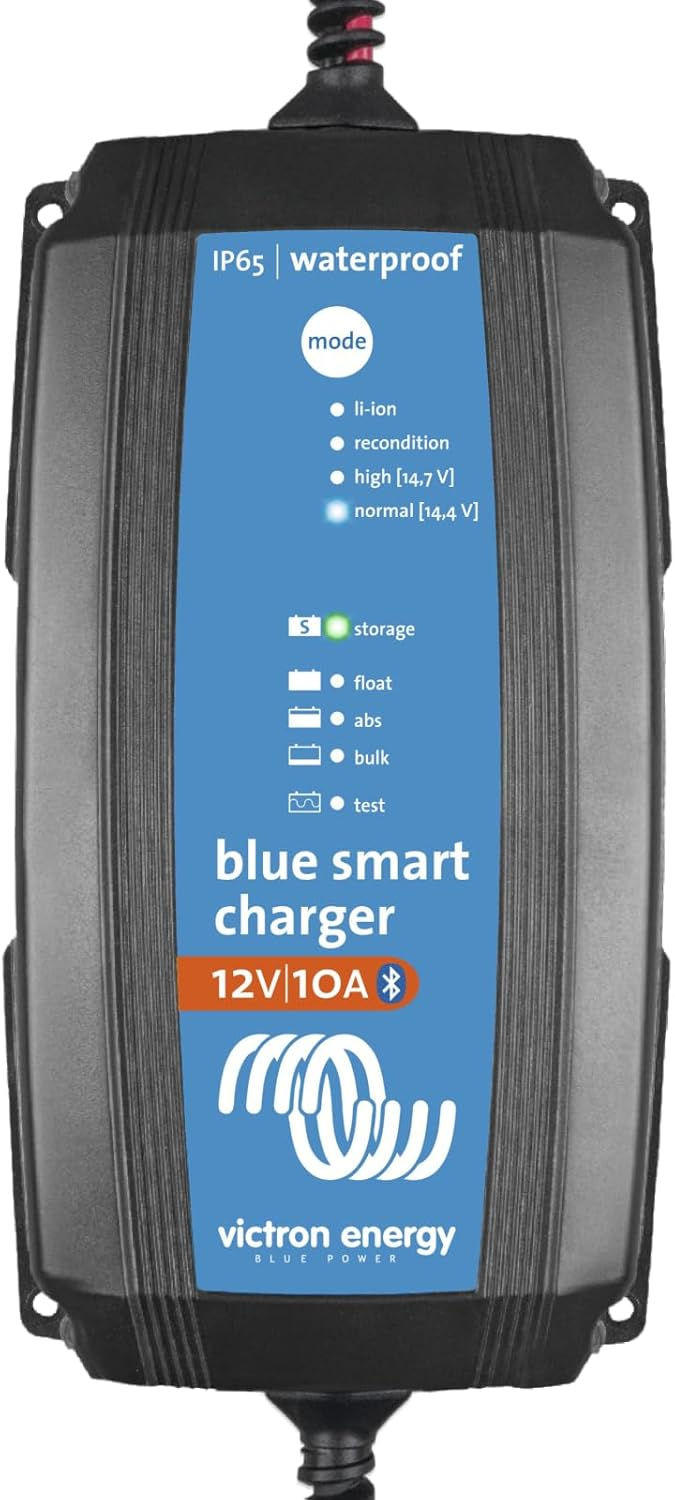
Victron Blue Smart IP65 10A
Mains charging done like an adult
This is the charger used when time and mains power are available.
Model: Blue Smart IP65 10A
The amperage matters. This is not about speed. This is about chemistry respect.
Why 10A is the sweet spot
For a 100Ah AGM battery:
• 10A ≈ 0.1C
• Low internal heating
• Long absorption phase
• Minimal plate stress
Charging stages (what actually happens)
1. Bulk — steady current up to absorption voltage
2. Absorption — voltage held, current tapers
3. Float — battery held full without overcharge
4. Storage — voltage reduced if left connected long-term
Professional reviews say:
• Exceptionally accurate voltage control
• Excellent long-term battery care
• Safe to leave connected indefinitely
Public reviews say:
• “I stopped worrying.”
• “Finally killed my unplug-replug habit.”
• “Wish I’d bought it years ago.”
This charger does not shout electrons at the battery.
It negotiates politely.
⸻
Victron SmartShunt

The device that ends all arguments
Voltage-based battery indicators are liars. Not maliciously—just structurally.
The SmartShunt sits in the negative line and measures reality.
What it tracks
• True state of charge (%)
• Real-time current (amps in / out)
• Voltage trends
• Amp-hours consumed
• Historical charge data
This is how I know:
• The Orion actually finished absorption
• The Blue Smart didn’t just “get close”
• The fridge uses exactly what I think it does
Once you have a shunt, you stop asking “I think it’s full?”
You start saying “It is.”
⸻
The Portable Capability Layer
Where Jackery comes in
The fixed system handles continuity.
Portable power handles capability and abuse.
Each Jackery exists to do a specific job—and not do the wrong ones.
⸻
Jackery Explorer 2000 v2

The heavy hitter: virtual hook-up mode
Core specs
• Capacity: ~2042Wh
• Chemistry: LiFePO₄
• Cycle life: ~4000+ cycles
• AC output: 2200W continuous
• Surge: ~4400W
What professionals say
Reviewers frequently describe it as “borderline home-backup class”. Praise focuses on:
• Inverter quality
• Thermal management
• Voltage stability under load
What owners say
• “I stopped watching the display.”
• “It just runs things.”
• “Confidence is the word.”
What it does here
• Microwave bursts
• High-draw cooking
• Heater boosts
• Emergency fallback power
This unit absorbs electrical violence so the AGM never has to.
⸻
Jackery Explorer 1000 v2

The everyday workhorse
Core specs
• Capacity: ~1070Wh
• Chemistry: LiFePO₄
• AC output: 1500W
• USB-C: 100W + secondary
Professional consensus
Often described as the “sweet spot” of the range: portable, powerful, and fast charging without bulk.
Real usage
• Full workdays (laptop + monitor + lights)
• Editing sessions
• Moderate cooking
• General daily flexibility
If the 2000 is infrastructure, the 1000 is daily life.
⸻
Jackery Explorer 300D

The DC-first philosopher
Core specs
• Capacity: ~293Wh
• Chemistry: Lithium-ion
• No AC inverter
• USB-C, USB-A, 12V
This unit is misunderstood.
By skipping AC entirely, it avoids:
• Inverter losses
• Fan noise
• Double conversion inefficiency
Who loves it
• Reviewers who understand DC efficiency
• Owners with USB-C laptops, cameras, drones
Who doesn’t
• People expecting a tiny kettle-runner
What it excels at
• USB-C laptops
• Camera and drone charging
• Phones and tablets
• Silent, ultra-efficient evenings
This is modern power, unapologetically.
⸻
Jackery Explorer 240 v2

The minimalist bridge
Core specs
• Capacity: ~256Wh
• Chemistry: LiFePO₄
• AC output: 300W
Reviews say
“Deceptively capable” is the phrase that comes up again and again.
Real use
• Legacy AC chargers
• Small mains devices
• Grab-and-go resilience
Small, polite, endlessly useful.
⸻
Cross-Feeding: When the System Becomes a Network
This is where the system truly levels up.
Mains → Blue Smart → AGM
The preferred, gold-standard method when hook-up or home power is available.
Jackery → Blue Smart → AGM
This is the clever bit.
Because the Jackerys supply clean AC, and the Blue Smart is a proper charger, I can do:
Jackery AC → Victron Blue Smart 10A → Leisure Battery
Why this matters
• Portable power can rescue infrastructure
• AGM is never a single point of failure
• Energy can be rebalanced deliberately
No direct DC bodging.
No uncontrolled voltage.
Victron still controls the chemistry.
⸻
A Full Real-World Scenario (Because This Is the Point)
Cold night. Several days off-grid.
• AGM running fridge, lights, heater electronics
• Jackery 300D powering laptop via USB-C
• Jackery 2000 v2 handling microwave bursts
• SmartShunt shows AGM slowly drifting down
Later:
• Plenty of energy left in Jackery
• Blue Smart plugged into Jackery
• AGM gently topped back up to a healthy state
• No rationing. No stress. No “we’ll see.”
That is not luxury.
That is design foresight.
⸻
What Professionals Agree On (Broadly, Calmly)
Across installer blogs, marine systems, and long-term reviews:
• Charging accuracy beats raw capacity
• Monitoring prevents silent failure
• Load separation increases lifespan
• Redundancy reduces anxiety
This system hits all four.
⸻
What Owners Say (Translated)
From public reviews and forums:
• “It just works.”
• “I stopped thinking about it.”
• “I finally trust my setup.”
Which is the entire point.
⸻
Final Thoughts: When Power Disappears from Your Mind
The goal was never maximum watts.
It was certainty.
This setup covers:
• Driving
• Off-grid parking
• Mains hook-up
• Emergency fallback
Every battery:
• Has a role
• Is charged correctly
• Is monitored honestly
Nothing guesses.
Nothing drifts.
Nothing dies quietly at 3am.
And the ultimate nerd victory?
When you stop thinking about power entirely—
because you already did all the thinking in advance.
Jackery to Victron Blue Smart 10A Charging Summary
Charging a 100Ah AGM leisure battery from 60% to 80% state of charge using a Victron Blue Smart IP65 12/10 (10A) charger requires approximately 360–400Wh from a Jackery power station. This corresponds to around 35% of a Jackery Explorer 1000 v2 or approximately 19% of a Jackery Explorer 2000 v2. The charging process takes roughly two hours and involves delivering approximately 21Ah to the battery, accounting for AGM charge acceptance and conversion losses through the inverter and charger. This SOC range represents the most efficient portion of the AGM charging curve, providing a predictable and repeatable energy cost for off-grid use.
When the solar panel is charging, the system is working in real time. Because the fridge is always on, some of the solar power is used immediately to run it, and any surplus goes into the battery. This means the battery voltage doesn’t always climb sharply during the day — and that is completely normal.
While solar is active, the voltage shown in the Webasto app reflects a live balance between power coming in and power being used. A steady daytime voltage in the low-to-mid 13-volt range usually means the solar panel is comfortably covering the fridge and supporting the battery at the same time, even if the number doesn’t appear to be “rising”.
As the sun fades, the most useful check is early evening. If the voltage settles in the mid-12s or higher, the battery has been meaningfully topped up and is well prepared for overnight fridge use and heating. Small rises and dips through the day are expected and simply reflect normal fridge cycling and changing sunlight.
Taken together, solar charging, an always-on fridge, and sensible Victron settings create a system that quietly looks after itself. The Webasto app voltage isn’t about chasing perfect numbers — it’s about spotting trends. When those trends are steady, the battery is healthy and doing exactly what it should.
⸻
AGM Battery State of Charge – Voltage Guide
(Approximate, real-world values)
• 12.8 V → 100%
• 12.6 V → 90%
• 12.5 V → 80%
• 12.4 V → 70%
• 12.3 V → 60%
• 12.2 V → 50%
• 12.1 V → 40%
• 12.0 V → 30%
• 11.9 V → 20%
• 11.8 V or below → Very low – recharge soon
These percentages are a guide rather than a guarantee, especially when the fridge or heater is running. Under light load, expect readings to be slightly lower than a fully rested battery — that’s normal behaviour, not a problem.


Comments